Best 35mm Darkroom Enlargers for Home Use UK (Tested & Ranked)
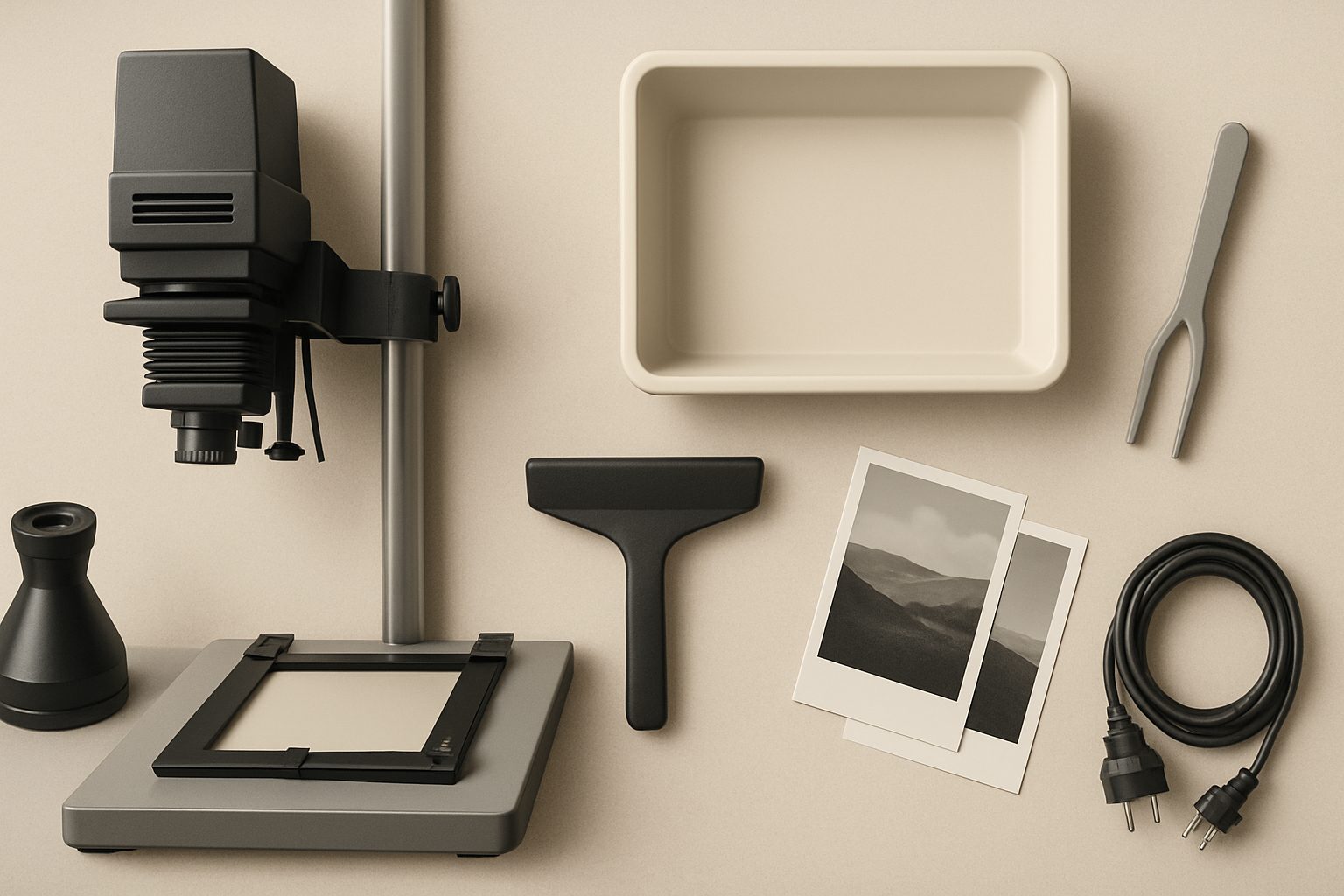
If you're setting up a home darkroom, the enlarger is your most critical purchase. Get it wrong and you're stuck with something either too fiddly for daily work or so expensive it gathers dust. This guide covers the 35mm enlargers that actually work for UK home printers—machines I've used or seen in long-term home setups, with honest assessments of what each one does well (and what it doesn't).
What matters in a home enlarger
Before the rankings: a quick reality check. Home darkroom space is usually cramped. You need something that's solid enough to produce sharp prints without being a beast to store or adjust. Autofocus is genuinely useful if you print regularly; older manual-focus heads are reliable but slower. Build quality matters because vibration kills sharpness on a 16×12 print, and you'll notice sloppy mechanics immediately.
The difference between a £150 bargain and a £600 machine often isn't the prints—it's the reliability and how quickly you can dial in an exposure.
Meopta Axomat 6 (best for beginners)
The Axomat 6 is the closest thing to an uncontroversial entry-level enlarger. It's a compact, straightforward machine designed for 35mm only, with a pop-up-style column that doesn't require a dedicated darkroom bench. Build quality is solid: Czech-made precision from an era when optical companies actually cared about tolerances.
What works: The optics are genuinely good. A 50mm lens will produce sharp, contrasty negatives up to at least 10×8. The friction adjustment for focusing is smooth, and it's light enough to store in a cupboard. The height is manageable in tight spaces. It's dead reliable and parts (when you need them) are affordable.
What doesn't: It's manual focus throughout—no autofocus option. The negative carrier, whilst adequate, isn't the smoothest to swap negatives in and out of. The enlargement range is limited if you ever want really big prints. And the column can wobble slightly if your baseboard isn't perfectly level, which matters.
Best for: Hobbyists starting out, or people who already know they'll print mostly 8×10 or smaller. If you're methodical and patient, this won't frustrate you.
Durst M600 (best for regular home printing)
The Durst M600 sits at the sweet spot between compact and capable. It's a proper darkroom enlarger, modular, with several focus options depending on your budget. The optical quality is excellent, and Durst machines have a reputation for rock-solid reliability across decades.
What works: The engineering is efficient—less fuss, more printing. You can upgrade the head (adding autofocus or colour capability) without replacing the entire machine. The negative carriers are precise and easy to use. It's genuinely steady; vibration is minimal even on cheap baseboard setups. Lenses perform well, and the height adjustment is generous for larger prints.
What doesn't: It requires proper bench space—it's not a tuck-away enlarger. The modularity means you'll pay more upfront if you want autofocus, and older models may need servicing. It's heavier than the Axomat, so moving it or storing it isn't trivial.
Best for: People committing to regular printing. If you're going to print at least monthly, this pays for itself in reliability and speed.
Kaiser Bandmatik (best for mixed formats)
If you think you might eventually shoot medium format but want to start with 35mm, the Bandmatik does both competently without costing like a proper 6×6 enlarger. It's German precision on a tighter budget than the alternatives.
What works: Exceptional lens optics. The focussing screen is bright and easy to see. It handles both 35mm and medium format with genuine switching rather than awkward adapters. Build quality is typical Kaiser—precise and uncompromising. The height is good for most home setups.
What doesn't: Focusing is fully manual, and swapping between formats requires actually changing the lens and negative carrier (it's not automatic). It's heavier and bulkier than a 35mm-only machine. You're paying for medium format capability whether you use it or not.
Best for: Photographers already mixing film formats, or those certain they'll eventually move up. Don't buy it as a "maybe someday" investment; the premium doesn't pay off if you stick with 35mm alone.
Buying used: what to actually check
Most home darkroom enlargers on the UK second-hand market are pre-2000 machines. Age doesn't matter as much as condition. Check for:
- Lens element damage: Hold it up to light. Any fungus (white spots) or haze inside the lens means optical compromise.
- Column wobble: Loosen the base and try to rock the column gently. More than a millimetre of play is a warning sign.
- Negative carrier resistance: It should slide smoothly. If it sticks, the metal's warped and prints will be uneven.
- Lamphouse function: If buying untested, assume the bulb's dead. Replacements are cheap, but test the circuit if you can.
A worn machine from a professional darkroom (studios that closed) is often more reliable than a machine from someone's garage that's been unused for a decade.
The money question
Used: £80–£350 for a decent manual-focus Axomat or Durst without autofocus. Autofocus heads add £200–£400 to used prices.
New (rare in the UK): £500–£1200. Most UK suppliers stock Durst parts and some Kaiser models; expect long lead times for anything Chinese-made and untested locally.
Storage-wise, assume you need a dedicated 1.2×0.6m space minimum. Baseboard, column, lamphouse, and negative carriers take room.
Final advice
Start with what you can afford to buy once. The Axomat 6 will teach you everything about darkroom printing without expensive failures. The Durst M600 is the machine you keep for twenty years. The Kaiser is for people who already know the game. All three will produce prints that are sharper and more satisfying than anything you've printed digitally.
Buy from UK sellers if possible—repairs and parts are quicker, and you avoid VAT surprises on imports. And honestly, the enlarger isn't where the money bottleneck is. Paper, chemistry, and a decent safelight matter more.
More options
- Darkroom Enlargers (various brands) (Amazon UK)
- Enlarger Lenses (El-Nikkor, Rodagon, Componon-S) (Amazon UK)
- Darkroom Timers & Exposure Meters (Amazon UK)
- Ilford Multigrade Darkroom Paper (Amazon UK)
- Darkroom Starter Kits & Accessories (trays, easels, chemicals) (Amazon UK)