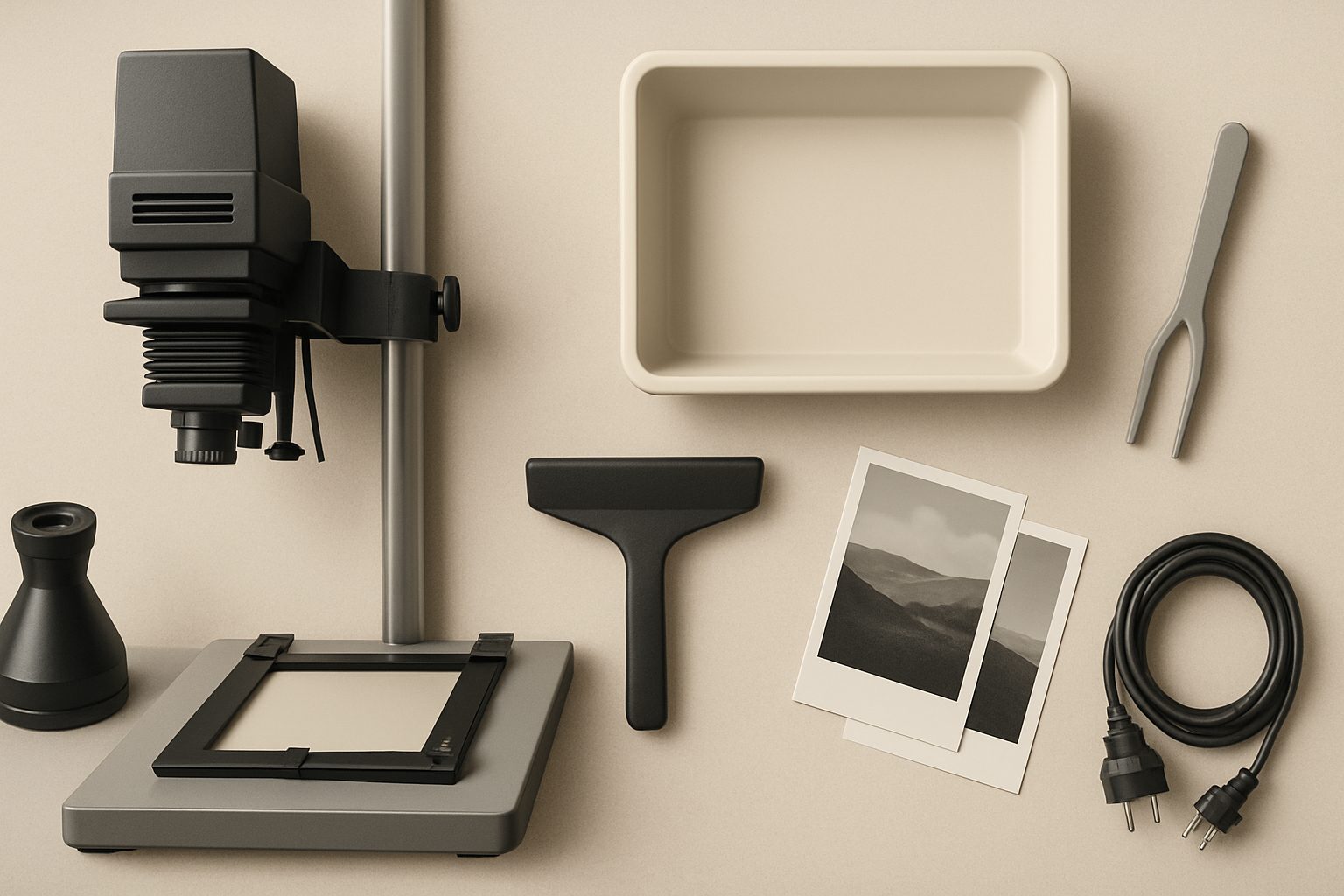
Best Darkroom Enlargers for Small Spaces UK — Compact Picks for Bathrooms & Cupboards
If you're itching to get back into film printing but your spare room doesn't exist, you're not alone. A growing number of UK photographers are reclaiming small spaces—spare bathrooms, converted cupboards, even under-stairs hideaways—as functional darkrooms. The bottleneck isn't chemistry or technique; it's finding an enlarger that actually fits. Most traditional models are tall, rigid, and demand a dedicated workbench. But there are clever alternatives designed exactly for this constraint.
The Challenge of Compact Darkroom Design
Space constraints aren't just about footprint; they're about ceiling height. A standard 4×5 enlarger tower can reach 1.5 metres or more when the head is raised for reasonable magnification. In a bathroom with a 2.4-metre ceiling, you've got headroom. In a built-in cupboard or under a sloped attic, you haven't. The solution lies in two directions: folding-column models that collapse dramatically when not in use, and low-profile designs that sacrifice some magnification range but stay compact all the time.
Folding-Column Enlargers: The Game-Changer
The Durst M600 is the benchmark here. This Swiss-made enlarger uses a distinctive folding column that collapses down to roughly 60 centimetres tall, making storage genuinely manageable. When deployed, it extends to give you roughly 30 centimetres of working height—enough for A4 prints from 35mm negatives without excessive magnification. The optics are solid; it's been around since the 1970s and you'll find plenty of secondhand units in UK markets.
What makes the Durst practical for tight spaces isn't just the fold; it's the build. The column is rigid when extended, so vibration—a real issue with some budget folder models—isn't a problem. The negative carrier is standard, compatible with most glassless carriers, and the lens board accepts standard 39mm thread lenses. You're not locked into proprietary kit.
The trade-off is magnification range. In a 60-centimetre-tall setup, you're limited to roughly 4× magnification from 35mm. That's fine for contact prints and modest enlargements up to A5 or A4, but if you're regularly printing bigger, you'll feel the constraint. It's also a single-format beast—if you shoot medium format, you'd need a separate carrier or a different enlarger entirely.
The Meopta Axomat 5 is a less-discussed alternative. Czech-made, with a more compact footprint than even the Durst, the Axomat is fundamentally a low-profile design rather than a folder. It's lighter, which matters when your darkroom is a rented flat and transport is awkward, and the optical path is clever enough that you can get 5× magnification or so from a modest column height. The trade-off is portability over features—there's no zoom, no tilt-shift adjustments. It's a straightforward machine: negative in, light on, focus, print. That simplicity is an advantage if space is at a premium and you don't need extensive flexibility.
Both are best sourced secondhand via eBay, photography forums, or the occasional specialist dealer. New enlargers in this class are rare; manufacturers largely abandoned the compact segment decades ago.
Height Clearance: The Real Metric
When shopping for a space-constrained enlarger, ignore advertised magnification limits and think in terms of actual column extension. Measure your ceiling height, then subtract 30 centimetres for your head and 10 centimetres of safety margin. That's your working column height budget.
Many compact enlargers are quoted with height only when fully retracted. Ring the seller or dig into manuals for the fully-extended figure. A Durst that's 60 centimetres collapsed might be 120 centimetres extended—still manageable in most rooms, but tight under a sloped ceiling or in a dedicated cupboard.
For bathrooms, use the space above the toilet cistern or sink. A small table—roughly 60 centimetres high, 50 centimetres square—works better than a full darkroom bench. This keeps the enlarger base lower and buys you precious centimetres of working height. Nesting tables or folding variants from IKEA or Screwfix are worth a look; they're cheap, sturdy enough, and collapse when you're done.
Essential Accessories for Tight Setups
Once the enlarger is in place, accessories become your real challenge. In a small space, everything competes for room.
Glassless carriers are essential. They're thinner than glass-sandwich carriers and reduce vibration in compact setups. A standard 35mm glassless carrier is under £20 and cuts at least a centimetre off your light path.
Red safelight bulbs matter more in a confined space. A weak safelight in a large room is invisible; in a cupboard, it's blinding. An LED safelight (roughly 10W equivalent) from Fotospeed or Paterson lets you see without drowning the room in red. They run £30–50 and are worth every penny.
Adjustable easels beat fixed ones in a tight darkroom. A Saunders LPL or similar four-bladed easel lets you work down to postcard sizes or go full A4, using just one tool. Fixed 5×7 easels are inflexible and take up dedicated space.
Drying racks are the silent killer of compact darkroom logistics. Wall-mount versions or over-door variants from photography suppliers keep prints off the bench surface entirely. A single tier of a Paterson drying rack takes roughly 10 centimetres of wall space and holds dozens of A4 prints.
The Practical Reality
A small-space darkroom works. It's not glamorous, it's not roomy, but it's printable. The Durst M600 or Axomat 5 paired with a modest table, glassless carriers, and sensible safelight gives you a fully functional darkroom in less than a cubic metre of space. Storage, when not printing, is straightforward—a narrow cupboard or under-bed box keeps everything together.
The constraint forces discipline: you print with intention, not endless test strips. It's closer to how darkrooms worked forty years ago, and that's not a bad thing.
More options
- Darkroom Enlargers (various brands) (Amazon UK)
- Enlarger Lenses (El-Nikkor, Rodagon, Componon-S) (Amazon UK)
- Darkroom Timers & Exposure Meters (Amazon UK)
- Ilford Multigrade Darkroom Paper (Amazon UK)
- Darkroom Starter Kits & Accessories (trays, easels, chemicals) (Amazon UK)