Best Darkroom Enlargers for Home Use in the UK (2026 Guide)
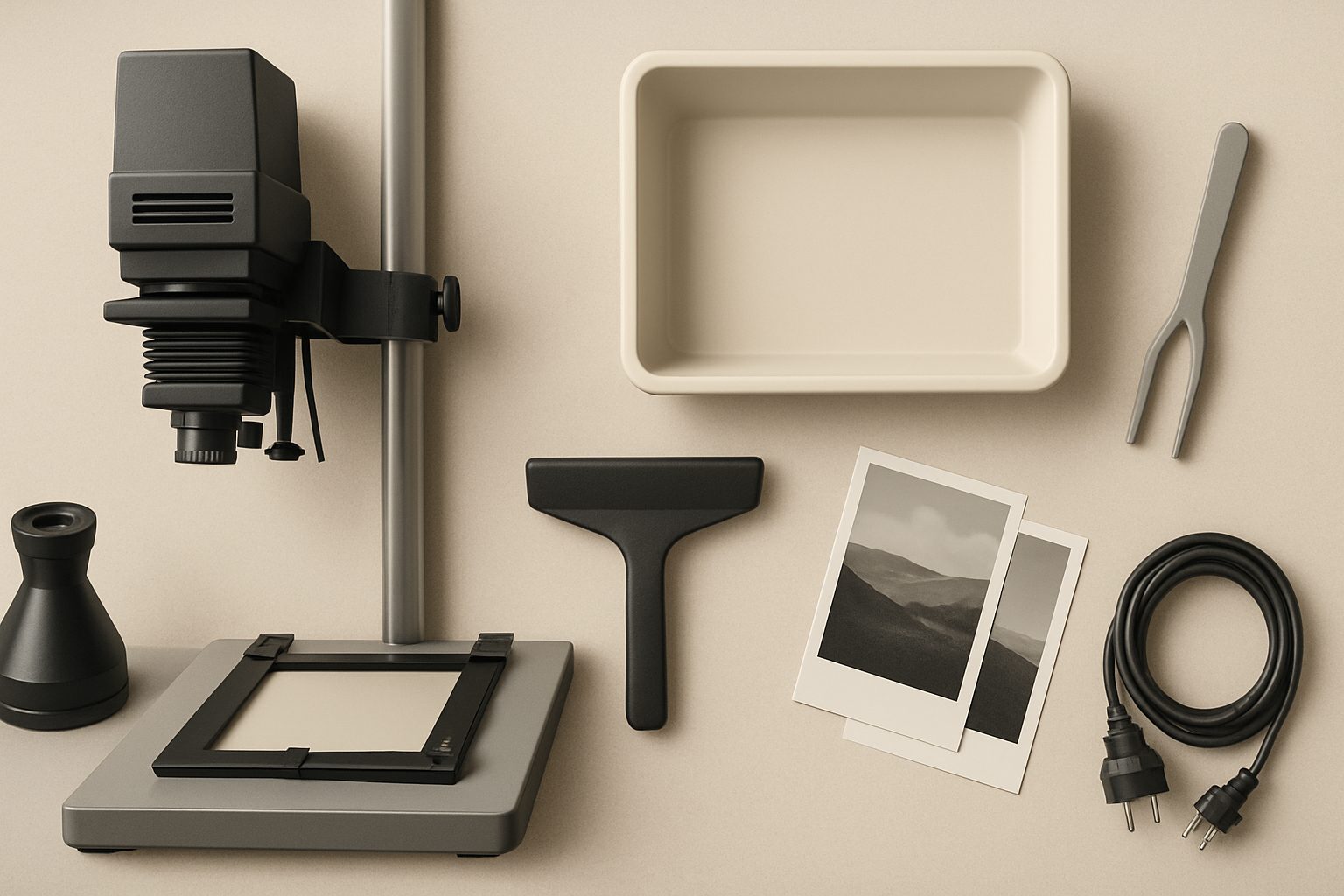
If you're setting up a home darkroom, the enlarger is the single most important piece of equipment after your enlarging paper. It determines image quality, format flexibility, and how much time you'll spend burning and dodging. After several years using and maintaining various models in small darkrooms across the UK, I've found that what matters most isn't the newest enlarger—it's finding one that matches your actual printing workflow and format needs.
What Makes a Good Home Enlarger?
Before diving into specific models, understand what separates reliable home enlargers from poor ones. Build quality is paramount: loose column assemblies, worn focusing mechanisms, and creeping light leaks turn what should be enjoyable into frustrating work. Optical quality matters, but a decent six-element lens performs well enough for typical darkroom prints up to A3. What really affects your results is stability, repeatability, and how comfortable the working height feels after an evening of printing.
Format flexibility (35mm, 6×6, 4×5) is tempting on paper but rarely essential in practice. Most home printers specialise in one or two formats. Buy for what you'll actually shoot, not hypothetically use. Spare parts availability and repair support matter more than you'd think—a professional refurbishment run to £300–400, so finding serviceable gear saves money long-term.
Durst Enlargers: The Workhorse Choice
Durst, the Austrian manufacturer, produced solidly engineered enlargers throughout the 1970s–1990s. Models like the Durst L1200 and L1500 (designed for 35mm and 6×6) are plentiful on the UK secondhand market, typically selling for £150–350 depending on condition and completeness.
The L1200 is compact and ideal if space is tight. Column height limits you to roughly A3 prints, which suits most hobbyists. The focusing wheel is smooth, the negative carrier doesn't bind, and replacement lenses and condensers are easily found. The main weakness: older models may have yellowed diffusers that reduce light output, requiring longer exposures. This is a quick fix—blanks from photo suppliers cost under £20.
Durst's strength is reliability without fussiness. Once set up and aligned (a 20-minute job), it prints consistently. The learning curve is flat, and parts cost relatively little. For a first enlarger or rebuilding a darkroom after years away, a clean Durst is hard to beat.
Leitz Focomat: Premium Build, Premium Price
Leitz Focomats (particularly the V and V35) represent the opposite end of the spectrum: German engineering with a price tag to match. On the secondhand market, you'll find them at £400–800 for a V35 in good order, or £600–1200 for a Focomat C or 5C.
What you're paying for is tolerances that feel noticeably tighter than budget models. The focusing mechanism resists drift, the negative carriers hold film genuinely flat, and the optical path doesn't shift as you adjust magnification. If you're printing 16×20 or larger from sharp 35mm negatives, the difference is real. Focomats also handle 6×6 format beautifully via changeable carriers and condensers.
The catch: repair and parts are expensive. Focomats need regular maintenance (dust on the condenser lenses degrades light output), and specialists command £100+ per hour. If you buy a broken one assuming a cheap fix, you may regret it. Hunt for examples that are mechanically sound and include original packaging and instruction manuals—these typically fetch higher prices but carry less hidden damage.
Meopta Axomat: The Overlooked Middle Ground
Less celebrated than Durst or Leitz, Meopta's Axomat series (late 1960s–1980s Czech manufacture) deserves attention from UK home printers. You'll find Axomats for £100–250, making them accessible entry points.
The optical quality is respectable, build is robust, and they handle both 35mm and 6×6 well with the right carriers. The main limitation: cooling. Meopta's diffuser condenser can run hot during extended printing sessions, and some models lack adequate ventilation around the lamp housing. On a warm day printing eight A3 prints in succession, you may notice fading light output as the head thermally stabilises.
This isn't a dealbreaker—it just means longer exposures or a desk fan nearby. Meopta parts are less common than Durst's, but serviceable units still find their way to UK eBay and specialist suppliers. It's a solid choice if budget is tight and you're printing 35mm primarily.
Focomat V/VC and Besseler for Large Format
If your interest lies in 4×5 or larger formats, options shrink considerably. Focomat VC heads (accepting larger condensers and lenses) handle 4×5 competently, though they're rare and pricey (£800–1500). American Besseler models (chiefly the 23C series) were never popular in the UK, but secondhand stock does appear on import sites; expect to pay £600–1000 and budget for potential electrical rewiring to UK standards.
Large-format enlargers introduce their own complexity: column rigidity becomes critical, and the lens brightness required is high. Honestly, unless you're committed to contact printing or enlarging 4×5 negatives regularly, the added expense and space demands rarely justify it for casual home printing.
Comparison at a Glance
| Model | Format | Magnification | Condition Hunt | Budget | Best For | |-------|--------|---------------|-----------------|--------|----------| | Durst L1200 | 35mm, 6×6 | Up to A3 | Easy; plentiful | £150–350 | First enlargers, tight spaces | | Leitz Focomat V35 | 35mm, 6×6 | Up to A2 | Moderate; check mechanically | £400–800 | Sharp large prints, longevity | | Meopta Axomat | 35mm, 6×6 | Up to A3 | Moderate; fewer spares | £100–250 | Budget-conscious 35mm users | | Focomat VC | 4×5 and smaller | Varies | Hard; specialist suppliers | £800–1500 | Large-format, contact prints |
Finding and Assessing Used Stock
Most home printers acquire enlargers secondhand. Gumtree, Facebook Marketplace, and specialist photography shops across the UK see regular stock. When inspecting, check: negative carrier flatness, lens element cleanliness, smooth focus travel, and any audible rattles in the column.
Avoid models with yellowed condensers, binding focus wheels, or corroded electrical components. Light leaks around the head or lamp housing are fixable but tedious. Ask whether the original instruction manual and lens are included—these are valuable for setup and future troubleshooting.
Final Thoughts
The "best" darkroom enlarger isn't the newest or most versatile. It's the one whose format and size match your negatives, whose condition is sound enough to print reliably, and whose cost leaves you with money for a decent lens and timer. A 30-year-old Durst or Meopta, well-maintained, outperforms a neglected Focomat every time.
Spend your first darkroom season learning to print beautifully on whatever you've chosen, not upgrading endlessly. The enlarger is a means, not the goal.
More options
- Darkroom Enlargers (various brands) (Amazon UK)
- Enlarger Lenses (El-Nikkor, Rodagon, Componon-S) (Amazon UK)
- Darkroom Timers & Exposure Meters (Amazon UK)
- Ilford Multigrade Darkroom Paper (Amazon UK)
- Darkroom Starter Kits & Accessories (trays, easels, chemicals) (Amazon UK)