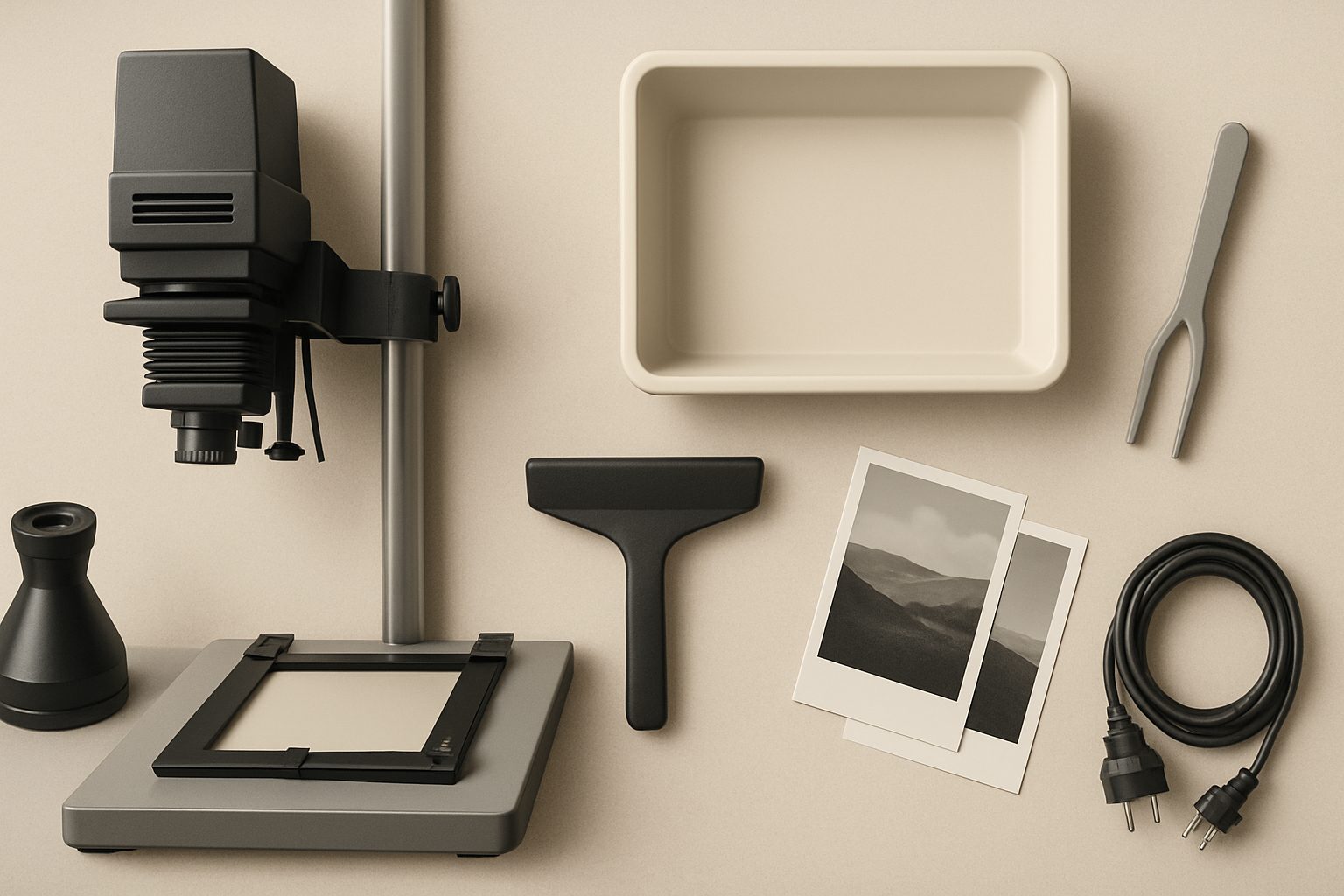
Best Medium Format Enlargers for Home Darkroom UK — 6×6 to 6×9 Picks
Stepping up from 35mm enlargement to medium format is transformative. The negative size jump—from 24×36mm to 6×6cm or 6×9cm—means you're printing from significantly richer original material, which translates directly to print sharpness and tonal range, even at modest enlargement ratios. But the equipment isn't plug-and-play; medium format enlargers require different light sources, condensers, carriers, and lenses than 35mm models.
If you're building or upgrading a UK home darkroom, the three machines that dominate the used market and offer genuine long-term value are the Durst M800, Durst M900, Leitz Focomat V35, and Meopta Magnifax. Each handles 6×6 natively; the Durst models and Magnifax extend to 6×9. This guide covers what separates them, what to watch for on the second-hand circuit, and what ancillary kit you'll need to actually use them.
Why Medium Format Matters for Home Printing
A 6×6cm negative contains roughly four times the information of a 35mm frame. In practical terms, that means cleaner enlargements, finer detail in shadows and highlights, and the ability to push your working speed—or exposure latitude—further before image quality suffers. Most home darkroom workers find their sweet spot printing 6×6 or 6×9 negs at roughly 8×10" to 11×14" without hitting the grain ceiling that stops them with 35mm work.
The trade-off is cost and complexity. Medium format enlargers are heavier, more finicky with alignment, and historically less common than 35mm kit. Finding one in the UK second-hand market requires patience, but when you do, the value is usually there; these machines were built to outlast fashion.
Durst M800 and M900
The Durst M800 is the workhorse standard. It handles 35mm up to 6×6cm on a common baseboard, prints to roughly 16×20" comfortably, and uses a straightforward halogen light source with a simple condenser. The M900 is mechanically identical but includes a diffuser head option alongside the condenser, giving you flexibility in print contrast and grain visibility.
Both machines are tall—expect to lose around 6 feet of ceiling height to the column—and require sturdy benches. The M800 typically retails on Ebay or specialist forums for £400–£700 complete with lenses; the M900 runs £600–£900 depending on condition and included optics. Parts availability in the UK is reasonable; new condensers, carriers, and lights are still manufactured by third parties, though original Durst spares are thinning out.
Build quality is Swiss-engineered. Focusing is smooth, baseboard adjustments are precise, and the machines tolerate age gracefully—a 30-year-old M800 in decent condition will print as accurately as a new one. The halogen lamp gets warm after 15–20 minutes; you'll want a cooling period between sessions, particularly in summer.
For the upgrade path from 35mm, the M800 and M900 are unbeatable value. If you already own a 35mm Durst enlarger, the medium format carriers and lenses bolt straight on; you're essentially extending an existing system rather than buying fresh.
Leitz Focomat V35
The Leitz Focomat V35 is a different animal: a compact, single-lens enlarger specifically engineered for 35mm and 6×6cm work. It's considerably smaller than the Durst—you can tuck it into a corner—and lacks the modularity of larger format machines. The optical path is fixed; you're changing carriers and condensers but not lens turrets.
The real distinction is precision. Leitz built these for professional use in commercial labs, and the tolerances show. The focussing mechanism is feather-light and repeatable to fractions of a millimetre. Exposure is more even than on comparable enlargers because the optical design is fundamentally tighter. If print consistency matters more than space, the Focomat is worth the premium.
You'll pay £800–£1,400 for a Focomat V35 in working condition. Parts are scarcer than Durst equivalents; new lenses are expensive. The machine also maxes out around 8×10" enlargements before diffusion becomes visible—fine for contact sheets and portfolios, tight for wall-size work. Used Focamats in the UK crop up on specialist forums and auction sites, but infrequently. The wait is usually worth it.
Meopta Magnifax
The Meopta Magnifax is a Czech-engineered machine with a cult following among darkroom enthusiasts who value mechanical simplicity and lateral thinking. It's a heavy, no-frills enlarger that handles 35mm through 6×9cm with straightforward gear changes and a robust light housing.
The Magnifax prints big—easily to 16×24"—and the optics are genuinely excellent, particularly the later Magnitar lenses. It's less common in the UK than Durst or Leitz equipment, which means when you find one, the price is often negotiable. Expect £500–£800 for a working machine. The downside is that parts obsolescence is real; you're sourcing spares from European networks rather than local retailers.
The Magnifax suits photographers who tinker and enjoy mechanical systems. The learning curve is shallower than it might appear; once you understand the carrier system, adjustments are intuitive.
Lenses and Carriers: The Hidden Costs
None of these enlargers ship with the full complement of kit. You'll need a 6×6 or 6×9 carrier (glass or glass-less, depending on your film flatness preference), and potentially new lenses. A quality 80mm lens runs £80–£200 used; 100mm or 105mm lenses for 6×9 work add £120–£280. Factor these in before committing to a body-only purchase.
Practical Setup Considerations
Ensure your darkroom bench is solid—vibration from even small bumps shows in prints. Ventilation matters; these machines warm up noticeably, and stale air compounds focus drift. A basic masking system (easel or magnetic frame) costs £40–£80 and saves hours of fiddling with crop marks.
Making Your Choice
For most UK home darkroom builders, the Durst M800 or M900 offers the best balance of availability, cost, modularity, and long-term practicality. The Leitz Focomat V35 is the choice if consistency and compactness outweigh enlargement size; the Meopta Magnifax rewards patience and mechanical aptitude. All three are capable of genuinely fine work; the machine matters less than the discipline you bring to exposure, chemistry, and print technique.
Hunt second-hand specialist networks, ask for test prints, and be prepared to travel or negotiate shipping. A used enlarger isn't an impulse buy, but get the right one, and you'll own a tool that improves for decades.
More options
- Darkroom Enlargers (various brands) (Amazon UK)
- Enlarger Lenses (El-Nikkor, Rodagon, Componon-S) (Amazon UK)
- Darkroom Timers & Exposure Meters (Amazon UK)
- Ilford Multigrade Darkroom Paper (Amazon UK)
- Darkroom Starter Kits & Accessories (trays, easels, chemicals) (Amazon UK)