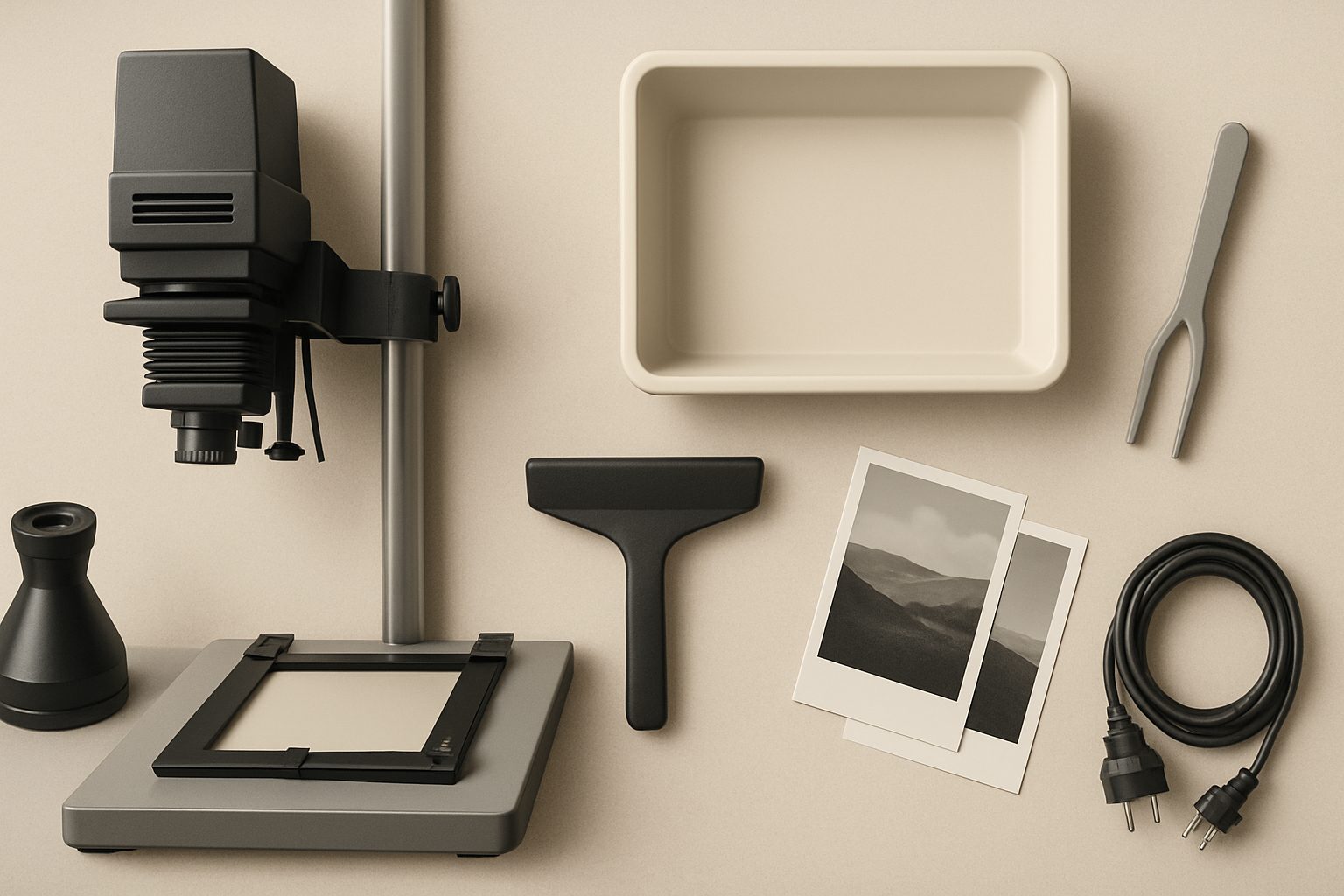
Best Darkroom Easels & Baseboard Accessories for Home Printing UK
A good easel is the foundation of consistent darkroom printing. It holds your paper flat and square under the enlarger, and the better your easel, the less time you'll waste fighting with curling paper and misaligned borders. If you're setting up a home darkroom in the UK, here's what actually matters when choosing an easel and the accessories that make a real difference.
What to Look For in a Darkroom Easel
An easel does three things: it keeps paper flat, it holds your borders consistent, and it lets you reposition for dodging and burning. The build quality directly affects how much faffing you'll do mid-print. A flimsy easel that won't hold paper flat means uneven exposure. One with sticky adjustments means you'll knock your border settings out of alignment when you're trying to dodge a shadow.
Most easels work on the same principle—two parallel bars that slide to set borders, held rigid by a flat baseboard. The difference is in the tolerances, the smoothness of the adjustments, and how well they actually grip your paper. You'll see claims about "universality" on a lot of UK listings, but honestly, what matters is whether the model works reliably with the paper sizes you're actually printing.
Top Easels for Home Darkrooms
Paterson Universal Easel
The Paterson Universal is genuinely workhorse kit. It's been in production for decades, and you'll find them in secondhand shops across the UK regularly. The 8×10 inch model handles everything from 5×7 up to 8×10, and it's rock solid once you get the hang of it. The border adjustments are via pop-out pegs and notches rather than smooth slides, which sounds crude but actually works—you get repeatable settings, and the pegs don't drift mid-print.
The downside: if you want borderless prints, you're struggling. The pegs sit proud of the paper, so you can't print edge-to-edge. The baseboard is steel, not aluminium, so it's heavier than newer designs. For home printing though, that weight is an asset—it sits put on your baseboard without creeping.
Saunders Trident
The Trident is the smooth operator of the three. It uses sliding bars with fine adjustments, so you can dial in any border width without messing with loose pegs. The metal construction is polished and modern-feeling. If you're printing variable sizes regularly, this is less fiddly than the Paterson because you don't have to hunt for the right peg holes.
The snag is that the slides can get sticky with dust in a home darkroom, and replacing the springs or bars later costs money. It's more finesse than the Paterson, which means if something wears, it's harder to repair with jury-rigging. The baseboard is also narrower, so it's more picky about alignment on your enlarger baseboard.
Heiland Easel
The Heiland (sometimes listed as Heiland TLR or similar) is less common in the UK secondhand market, but worth knowing about if you spot one. It sits between the two in philosophy—more adjustable than Paterson pegs, but heavier and more mechanical than Saunders. Genuinely excellent build quality, though you'll pay for it if you find one new.
Baseboard Size & Compatibility
Your enlarger's baseboard determines which easel you can actually use. Most UK home setups are on 16×20 inch baseboards or smaller. Before you buy, measure your baseboard dimensions and check the easel's footprint when fully extended. An 8×10 easel on a tight 11×14 inch baseboard is infuriating because you can't get enough reach to dodge the edges.
The Paterson Universal and Saunders Trident come in several sizes—5×7, 8×10, 11×14. The 8×10 is the sweet spot for home darkrooms if you're working up to that size. If you're mostly doing 5×7 or smaller, a compact easel saves space and cost.
Check that your enlarger allows easel height adjustment too. Some older models sit fixed, which limits which easels will focus properly. A baseboard that's too tall or too short throws your image completely out of focus.
Essential Accessories Worth Having
A decent set of dodging and burning tools makes or breaks print quality. Cheap plastic wands bend and heat up under the enlarger light. Cardboard discs from photo suppliers are fine but wear out. Worth buying proper brass or aluminium dodging sets—they're durable and they distribute heat so you get smoother transitions. Expect to pay £15–30 for a usable set.
A paper safe (a light-tight box to hold paper sheets) stops you wasting stock mid-print when someone opens the darkroom door by accident. Basic cardboard ones are functional. If you're printing frequently, a wooden or metal one with a sliding top is worth the extra outlay because it survives longer and handles repeated opening without creasing the paper.
A spare baseboard or two in different sizes lets you switch paper formats without yanking your easel out and readjusting each time. Old baseboards are cheap secondhand and genuinely useful.
Budget vs Premium
Secondhand Paterson or Saunders easels are your best value—£20–40 on eBay.co.uk or at photo fairs. They outlast new plastic-based equipment and actually improve with age because the notches bed in. New easels from UK suppliers like Fotospeed cost £60–150, which is reasonable if you're building a setup from scratch and want warranty cover.
The Bottom Line
For most UK home darkroom users, a Paterson or entry-level Saunders in an appropriate size will outlast your patience with the hobby. They're reliable, simple to maintain, and available on the secondhand market for very little money. Pick one that fits your baseboard, add a decent set of dodging tools, and you've got everything you need to print well.
More options
- Darkroom Enlargers (various brands) (Amazon UK)
- Enlarger Lenses (El-Nikkor, Rodagon, Componon-S) (Amazon UK)
- Darkroom Timers & Exposure Meters (Amazon UK)
- Ilford Multigrade Darkroom Paper (Amazon UK)
- Darkroom Starter Kits & Accessories (trays, easels, chemicals) (Amazon UK)